

The global edge AI market is expected to grow from $30 billion in 2026 to $118.7 billion in 2033, demonstrating its effect on how people’s devices and machines work.
When it comes to using edge AI in a commercial or industrial setting, it's important to understand what it is and how it works. This guide from Synaptics can help you learn more about edge AI and take advantage of its benefits.
An edge AI deployment is when AI learning models and algorithms are deployed onto physical devices, such as smart cameras, embedded processors and IoT sensors. These local devices are considered to be at the edge of the network, compared to the data center or cloud facility at the network’s center. Deploying these AI applications locally enables real-time processing that doesn't constantly rely on a cloud infrastructure.
Edge AI combines two existing disciplines — edge computing, which is when data is processed near its source, and artificial intelligence, which enables devices to understand, classify and then act on that data.
While AI applications operate on physical devices in an edge deployment, cloud AI carries out these processes on remote servers. The data is sent via the cloud from local devices to the cloud data center, where the AI processes it, before the response is sent back to the devices at the network edge.
By processing data locally, edge AI can improve operational efficiency and promote stronger data protection.
Many systems use a hybrid model, where time-sensitive inference is handled by edge AI, while cloud AI covers large-scale model training and the more complex tasks.
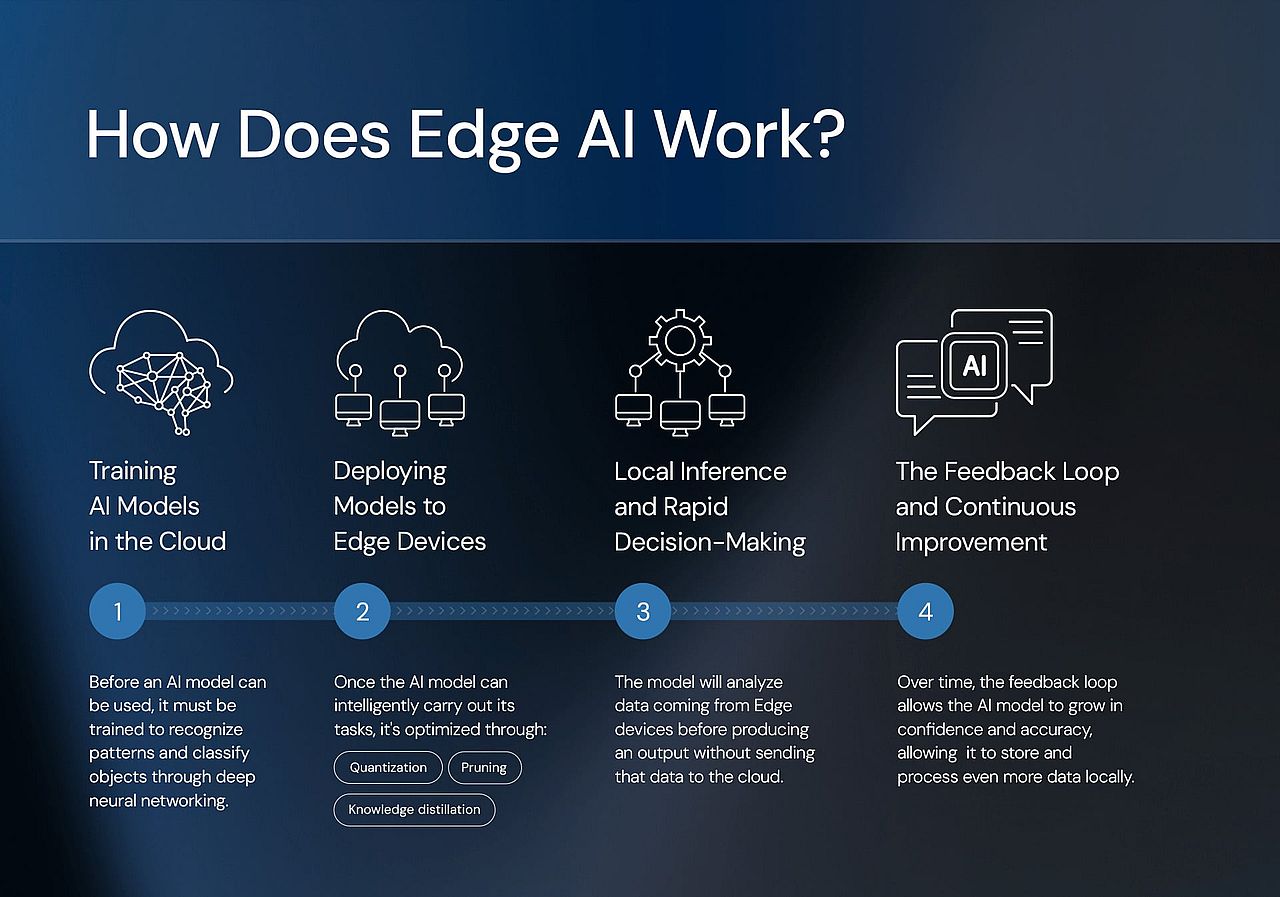
Edge AI carries out two key processes, training and inference. Training is how an AI model learns and gains the ability to understand data input, while inference is how the AI model uses its training to make predictions and decisions based on previously unseen data. Understanding these terms is key to understanding how edge AI works.
1. Training AI Models in the Cloud
Before an AI model can be used, it must be trained to recognize patterns and classify objects through deep neural networking. Since training requires exposing the model to large datasets and significant computational resources, it usually happens in the cloud or in a centralized data center.
While this may initially seem like a disadvantage, it's actually an intentional design aspect that takes advantage of the cloud's larger capacity for data storage and computational demands.
2. Deploying Models to Edge Devices
Once the AI model can intelligently carry out its designated tasks, it's optimized through various techniques, including:
Once the model has been optimized, it can be deployed to the edge environment, where the model will operate within the edge devices' power, memory and compute limitations. These devices can vary from microcontroller units (MCUs) for always-on, low-power sensing to more powerful microprocessor units (MPUs) for complex vision or audio workloads.
3. Local Inference and Rapid Decision-Making
Once the AI model has been deployed locally to the edge devices, it will infer data locally. The model will analyze data coming from edge devices before producing an output without sending that data to the cloud. Real-world scenarios could include:
This local inference is what allows edge AI to deliver low-latency performance and support data privacy.
4. The Feedback Loop and Continuous Improvement
While edge AI allows for more processes to be completed locally, that doesn't mean the system operates in isolation. Instead, when the model encounters an input that it's unsure how to classify, it will send the data back to the cloud for additional training. The updated and improved model is then sent back to the edge device.
Over time, this feedback loop allows the AI model to grow in confidence and accuracy, allowing it to store and process even more data locally. This continued learning is one of the key differences between edge AI and a static AI model.
Edge AI doesn't run on a single piece of hardware. Instead, it runs on an integrated system of components that work together:
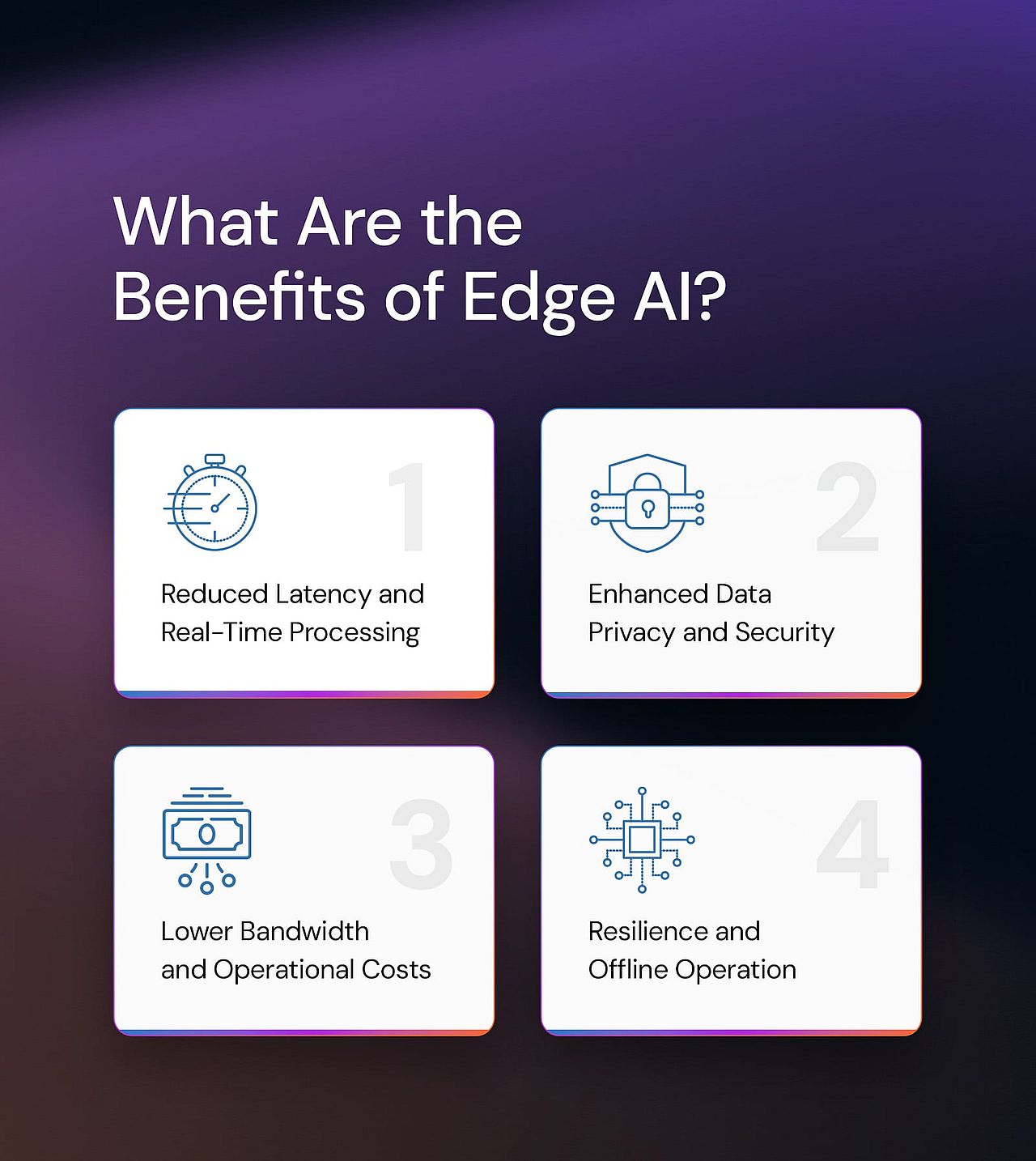
Edge AI can deliver tangible benefits to your Edge deployment, including:
Reduced Latency and Real-Time Processing
Since data is processed on a local device, edge AI often doesn't need to send data to a remote server and wait for a response, allowing for faster processing. This difference in processing speed is often beneficial, but it is critical for effective operations in some cases, such as:
Enhanced Data Privacy and Security
While there are ways you can improve the security of your cloud AI, sending data from your edge devices to the cloud inevitably affects your data security. As your data is transmitted from your devices to the cloud, it can become exposed to interception and increase the data footprint across the network.
By keeping your data processing on your edge devices, you remove this additional risk. This reduced risk becomes particularly important when you're working with sensitive data, such as biometric inputs and health readings or private audio and video files. In many cases, this enhanced protection can also support compliance with data privacy regulations.
Lower Bandwidth and Operational Costs
Edge AI reduces data transmissions to and from the cloud by sending only relevant insights or inputs, reducing bandwidth consumption. Instead of continuously streaming raw, high-volume data, such as hours of video footage, edge AI processes the data locally. This local processing lowers the costs of cloud data transfers and can reduce cloud storage fees, since less data will need to be stored.
For organizations that use many IoT devices, the cost reduction can be significant.
Resilience and Offline Operation
While cloud AI requires network connectivity, edge AI can continue operating even when network connectivity is interrupted or unavailable because inference happens locally. This ability of edge AI is architecturally built in and can be particularly appealing in industrial environments or remote locations where a stable network connection can't be guaranteed.
Edge AI can be useful in many situations and environments, but some industries can particularly benefit from this technology.
Manufacturing and Industrial Automation
In the manufacturing and industrial automation industry, edge AI's key function is often to provide real-time quality control and anomaly detection. By processing the data locally, edge AI allows the machinery to respond quickly to any potential issues and halt operations.
It's also used in the production machinery to support timely predictive maintenance.
Healthcare and Remote Patient Monitoring
Edge AI enables real-time monitoring in wearable and portable medical devices, making it a vital technology to countless people every day. From people who rely on a wearable medical device to monitor their health, to anyone treated by an ambulance crew that uses smart diagnostic equipment and scanners, this technology can impact their health.
Beyond delivering faster results, edge AI also means that these devices don't require a network connection to operate. This ability greatly expands where and when they can be used, with technology like wearable devices gaining popularity in the United States.
Medical devices that use edge AI can also enhance data security, since the patient's health information isn't transmitted to the cloud. By keeping the data local, patients can enjoy increased privacy.
Retail and Customer Experience
Retailers are increasingly employing edge AI to assist with:
Smart Home and Consumer IoT Devices
From smart speakers and thermostats to security cameras and washing machines, edge AI powers the intelligence in smart devices throughout the home. By processing inference locally on these devices, edge AI allows them to respond instantly to the conditions they were designed to recognize, be it a voice command, motion or user behavior, even when they don't have a network connection.
Local processing in consumer IoT devices also helps consumers protect sensitive household data, such as biometric inputs, audio and video.
Edge AI's impact on how smart devices operate is undeniable. These devices and machines can be found in homes, places of work and even in what people wear. While they carry out similar functions to smart devices that rely on cloud AI, edge AI devices can deliver increased efficiency, lower data costs and enhanced data security.
This story was produced by Synaptics and reviewed and distributed by Stacker.