

When parents talk about needing a village, they generally mean the people who show up when they need support, like a neighbor who watches their kid for an hour when they’re stuck at work.
As a new school year starts, that village is doing more than the phrase implies. Parents of school-age children now name an average of 2.35 sources of support for their child's mental health, according to a Grow Therapy survey of 1,386 U.S. parents of children under 18.
One of those sources has grown considerably. Nearly 82% of parents report having sought professional mental health support for their child, up from 62% in Grow Therapy's 2025 Student Mental Health Report.
But more parents reaching out has also meant more friction for them. The percentage of parents who said they felt judged for seeking help more than doubled year to year, as did a child's resistance to help.
The U.S. Surgeon General’s 2024 advisory on parental mental health and well-being states that 41% of parents report being so stressed on most days that they can’t function, one reason it advises raising a child as a shared responsibility.
To that end, family and friends remain the most common source of support, cited by 52% of parents whose child currently attends school.
But that’s no longer the whole story. Only 10% of parents rely on friends and family alone. Another 43% pair them with other resources, and 48% don't rely on friends and family at all, having built their child's support network from other sources.
That network already includes professional support for most families. Sixty-three percent of parents include at least one clinical source, such as a school counselor or therapist.
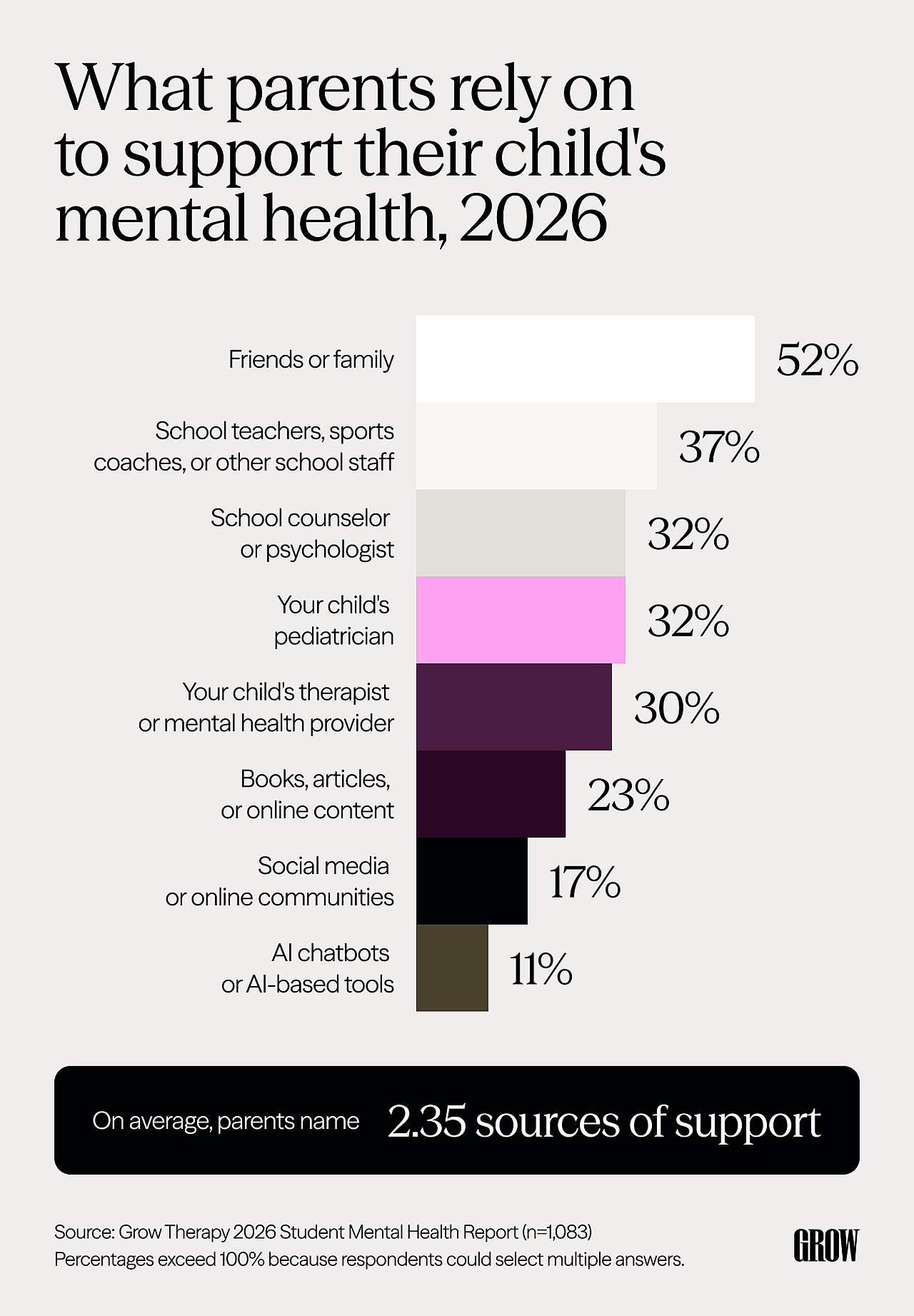
The village also stretches into digital spaces across generations, though unevenly. Among parents ages 18 to 29, 19% use AI chatbots to support their child's mental health, compared with 6% of parents 46 and older. The same pattern appears in social media and online communities: 25% of the younger parents use them, compared with 10% of older parents.
The proportion of parents who say their child experienced noticeable stress, anxiety, or sadness during the school year rose to 47% from 41%.
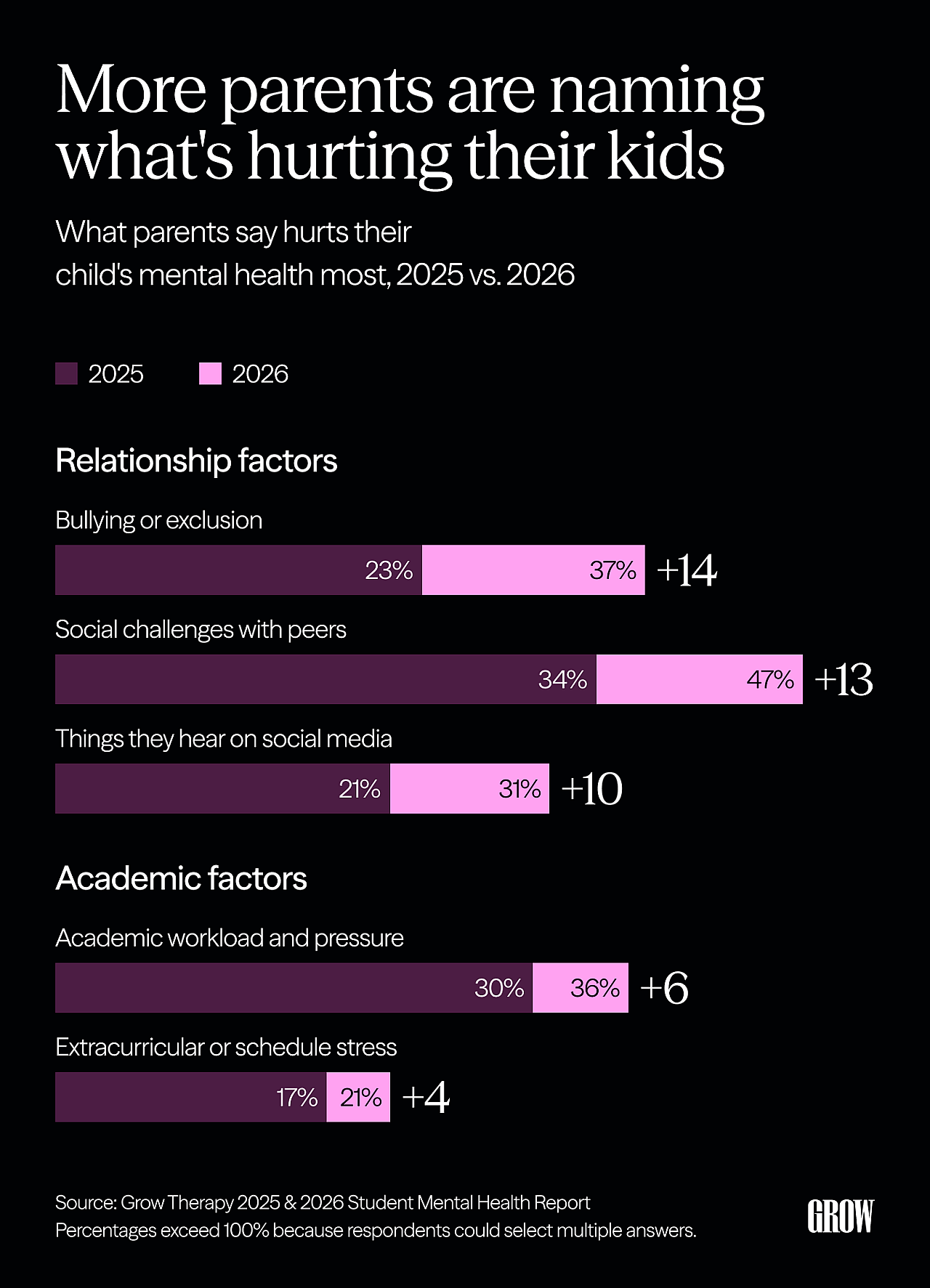
Social challenges with peers and friends remain the most-cited factor at 47%, up from 34%. Bullying or exclusion followed, at 37%, up from 23%. Academic workload and pressure increased from 30% to 36%, suggesting that relationships have a greater impact on students’ mental health than grades.
Students are reaching similar conclusions about the social side of their lives. Pew Research Center found that 48% of U.S. teenagers in 2024 said social media has a mostly harmful effect on people their age, up from 32% in 2022.
Part of the change may be that 80% of parents surveyed by Grow Therapy now report having at least one stressor affecting their child, up from 64%.
By contrast, the share of parents who feel very prepared or have a general idea of how to recognize signs of a struggle rose from 76% to 81%. Over the same period, a child's resistance to getting help increased more than three times as quickly.
Parents and their children also don't always identify the same risks. In a 2025 Child Mind Institute study of 1,000 parent-child pairs ages 11 to 22, parents were far more likely to name substance use as a top concern for youth mental health at 74%, versus 42% of children. Young people were more likely to flag AI and social media at 60%, versus 47% of parents.
The gap between parent and child perspectives is part of why other adults matter. A teacher or coach might see what a parent can't. A trusted clinician, meanwhile, can point to familiar signals such as a shift in mood or energy or escalating risk-taking. But consistency matters more than any one signal. If a child talks about hopelessness or hurting themselves, seek professional help right away.
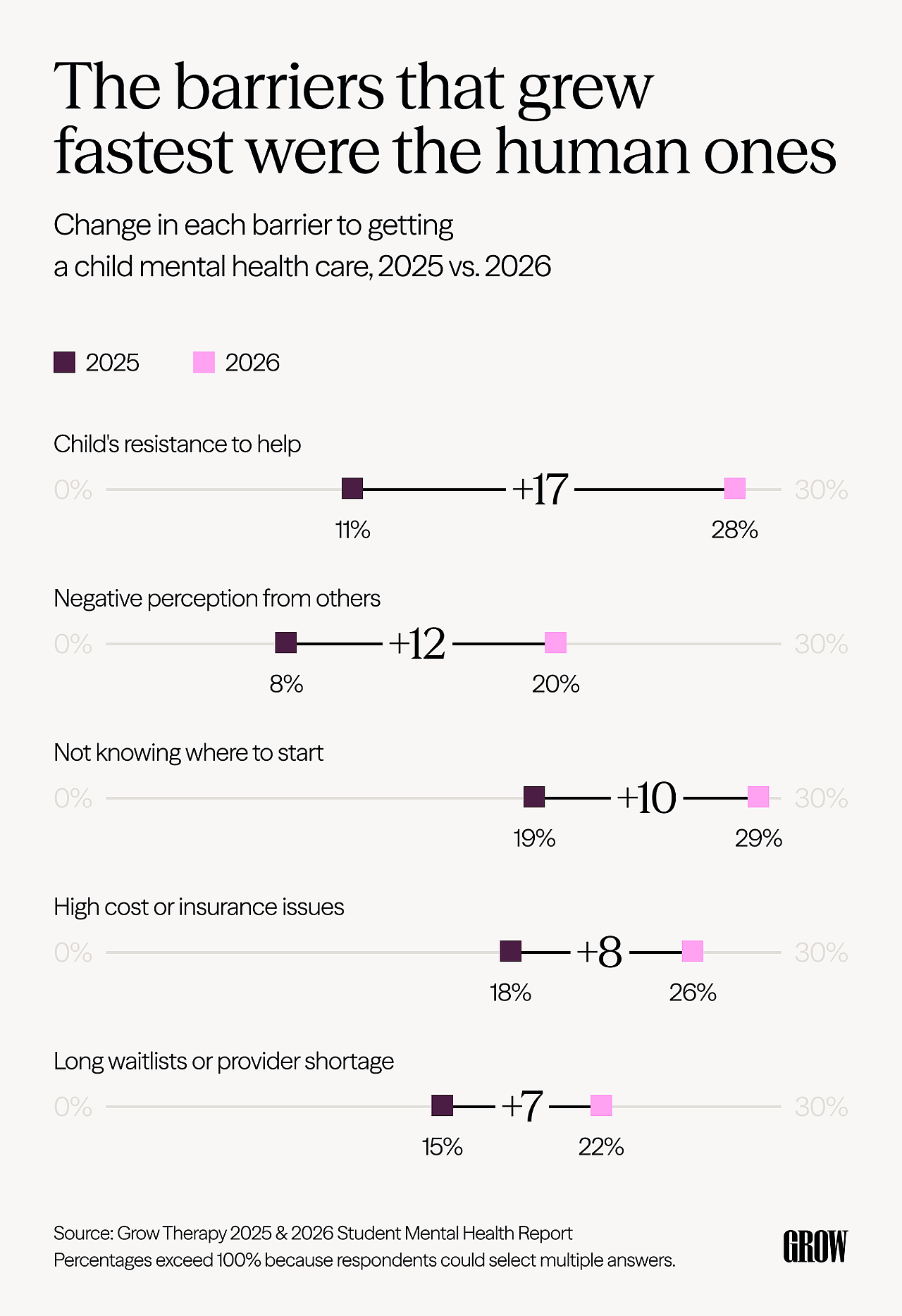
Every barrier to seeking mental health support for children we tracked in both years grew, though not evenly.
On average, the two relationship barriers grew roughly twice as fast as the logistical ones. The biggest increase was in a child's resistance to help, from 11% to 28%. The share of parents who said they felt judged by others rose from 8% to 20%. Meanwhile, logistical issues like not knowing where to start rose from 19% to 29%. Cost or insurance issues rose from 18% to 26%, and long waitlists rose from 15% to 22%.
Schools are one of the resources parents turn to, but most don't think they’re doing enough. Among parents with a child currently in school, 45% say their school does some, but not enough, to support student mental health, and 13% say it doesn’t support student mental health at all.
Parents’ requests are specific: more mental health education or awareness programs (44%), better communication between school and parents about a child's well-being (41%), anti-bullying programs or enforcement (37%), and access to a school counselor or psychologist (36%).
Among parents with a child currently in school, 63% say their child faces more pressure to succeed than they did at the same age, with 31% saying much more pressure.
These pressures shape what parents worry most about. Asked what concerns them most about their child’s future, 59% named overall happiness and mental well-being. That’s ahead of finding a stable, well-paying career (47%), affording a home or starting a family (39%), and getting into college (39%).
Parents cite unstructured activities as having the most positive impact on their children’s mental health. Time with friends leads (52%), with time outdoors or in nature close behind (50%). Both rank ahead of team sports (39%), visual arts or creative hobbies (34%), and music or performing arts (34%). What parents see doing the most good doesn’t require a fee or a schedule.
Grow Therapy surveyed 1,386 U.S. parents of children under 18 online via Centiment from July 17-21, 2026. Of those,1,083 (78.1%) said they were the parent or guardian of at least one child under the age of 18 currently attending school and answered additional questions about school support and daily activities. Data is unweighted; the margin of error is approximately +/-3 percentage points at a 95% confidence level. Year-over-year figures are compared against Grow Therapy's 2025 Student Mental Health Report, fielded by YouGov among 752 parents using different sampling and weighting, so comparisons should be read as directional.
This story was produced by Grow Therapy and reviewed and distributed by Stacker.