
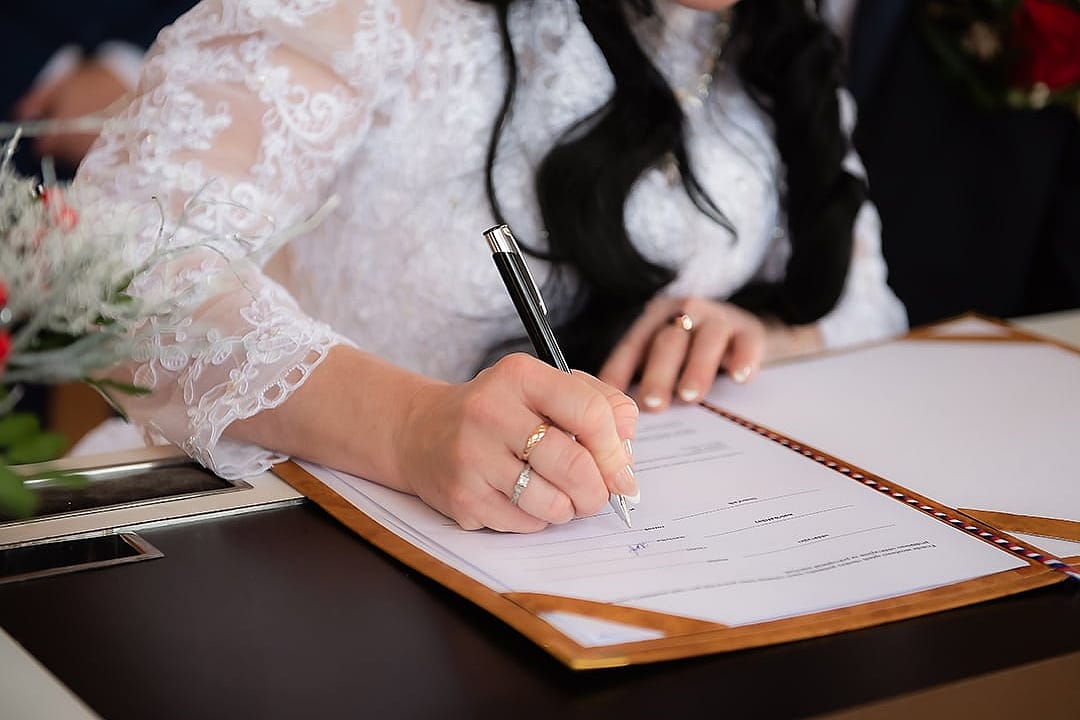

The fall is the most popular season for weddings. This means a lot of people are currently considering one of the most significant decisions of their soon-to-be-married lives: what to do with their last names.
Traditionally, there was one common answer. Nowadays, though, more and more couples are choosing a different path. In 2023, the Pew Research Center found that 79% of women in opposite-sex marriages took their husband’s last name, 14% kept theirs, and 5% hyphenated. Among unmarried women, 33% said they would take their spouse’s last name, 23% said they would keep theirs, 17% said they would hyphenate, and 24% said they had no clue.
The percentage of women taking their husband’s name is still high, but the default tradition is poised for change. AnyWho has broken down recent data from the National Center for Health Statistics, YouGov, Pew, and the Social Security Administration to see what it indicates about the direction of future surname trends.
The traditional path is still favored pretty heavily, but there’s a generational difference in Pew’s poll data. Of women who are between 18 and 49, 20% noted keeping their last name.
Just 9% of women over 50 took the same route. Education has a correlation, too. About a quarter of women with a postgraduate degree opted to keep their name compared with 13% of those with a bachelor’s.
A YouGov survey had a similar finding. From those polled in April of last year, 69% of married women reported changing their name. The survey also found that adults under 45 are more likely than older Americans to have positive views on couples combining their last names into a new last name without a space or hyphen and on couples taking each other’s last names as middle names.
With many couples beginning to look beyond the traditional naming convention post-marriage, they have a myriad of options to choose from:
With more couples choosing nontraditional options, there are downstream impacts. If they choose to begin a family, their name choices won’t necessarily carry straight down to their child. Their last name will need to be selected when they are born, and it can be different than what the parents chose for themselves. The naming process varies by state, so it’s worth checking the requirements where you live.
One of the single biggest mistakes couples make post-marriage is updating their records out of order. Several agencies will only accept a new name once a prior agency has confirmed it. If the change is made in the incorrect order, what should be a task that takes a couple of weeks can turn into a multi-month one. Update your records in the following order.
Before the wedding: When applying for your marriage license, decide on the names each of you will have. After you’re married, get certified copies of the certificate from the county or state that issued it, as each subsequent step will require that.
Social Security Administration: The SSA should come first because many other agencies will check a name against their records before accepting a name change. You will need to complete Form SS-5 and provide a certified marriage certificate, proof of identity, and proof of citizenship or immigration status. You may not be able to file online, and in that case, you will need to do it by mail or in person at a local field office. It should take a couple of weeks for your new card to arrive.
Employer and payroll: Once the Social Security card reflects your chosen name, update payroll and human resources records with your company. A mismatch between an employer’s tax records and the SSA is one of the most common triggers for IRS issues during filing season. The last thing you want when celebrating your matrimony is an audit.
State driver’s license or ID: Most DMVs across the country will require your updated Social Security card alongside proof of residency. It will, at the very least, require your certified marriage certificate.
Passport: You don’t necessarily need to do your passport after your state ID, especially if you have upcoming travel, but it usually is treated as a lower-priority item. The State Department will require your certified marriage certificate along with renewal paperwork. It’s also a longer process than a state ID change, which is all the more reason to defer it until later. If you have immigration paperwork in your old name, you should also ask what documents need a similar update. U.S. Citizenship and Immigration Services records aren’t automatically updated by a Social Security or state ID change.
Financial, insurance, and employment records: You’ll need to update all your financial accounts separately. The new driver’s license or Social Security card you’re issued will be required for proof.
Voting, housing, utilities, and digital accounts: Focus on all of your personal accounts only once all government accounts are taken care of. Voter registration, housing documents, utilities, and digital accounts like your email fall into this category. There aren’t often issues in delaying these, though it’s still best to get them taken care of as soon as possible.
To streamline the process and to ensure you don’t need to remember everything from scratch, the government maintains a comprehensive list of all items to change at USA.gov.
Before the wedding ever takes place, there are two major name-related decisions to tackle: what surname each partner will take and what surname their children will carry if it’s in the cards.
It’s also best to confirm the requirements your state has related to its vital records process for marriage and birth documentation via the National Center for Health Statistics site. This can help you and your partner avoid delays that would have otherwise occurred in the middle of the name-change process.
No single choice is more right than another. The data shows a noticeable movement away from the traditional choice, but that doesn’t mean it’s a poor option. The correct choice will be entirely dependent on you and your partner.
This story was produced by AnyWho and reviewed and distributed by Stacker.